MONOPOLY Live is what happens when a 90-year-old American board game collides with the live-streaming era of online gambling. Hasbro launched MONOPOLY in 1935, during the depths of the Great Depression, as an ironic critique of unchecked landlordism that sold tens of millions of copies anyway. In 2019, Stockholm-based Evolution Gaming, the world's largest live-casino studio, licensed the brand from Hasbro and built a Las-Vegas-style wheel-spin show around it. The result is now the highest-grossing live game show in the iGaming industry — broadcast 22 hours a day, hosted in six languages, watched by millions of players from a single Riga studio every month.
From Big Six to MONOPOLY: how the wheel got here
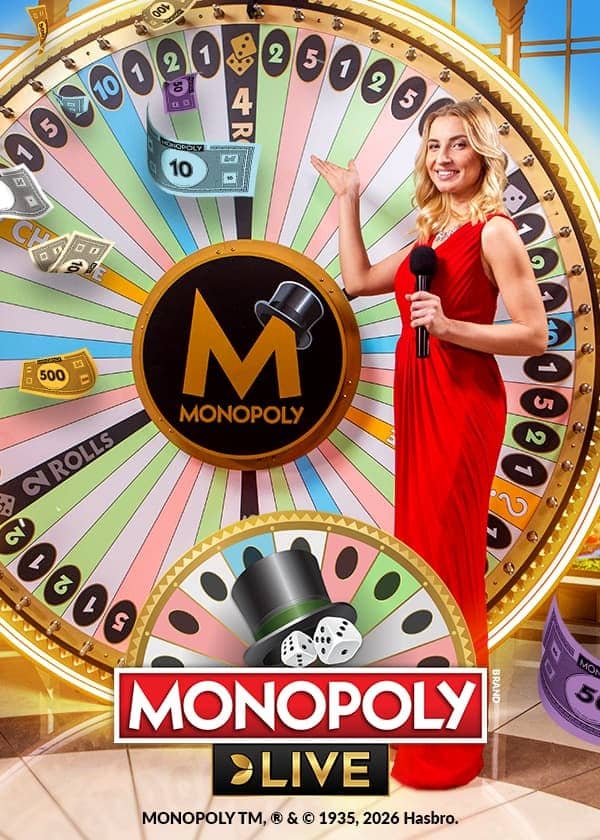
The 54-segment wheel at the centre of the game is a direct descendant of the Big Six wheel that has stood in physical casinos for more than a century. Evolution itself put a digital spin on the format in 2017 with Dream Catcher — the first live wheel game streamed to mobile players. MONOPOLY Live takes that same engine and wraps it in IP recognisable to anyone who has ever rolled doubles to get out of jail. The segments are not equally distributed: 22 of the 54 slots are simple 1× pay-outs, and only one slot triggers the headline 4 Rolls bonus. A "Top Slot" above the wheel spins on every round and sometimes attaches a 2× to 1,000× multiplier to a single segment — the single biggest source of variance in the published RTP.
Mr. Monopoly and the augmented-reality board
When the flapper stops on 2 Rolls or 4 Rolls, the studio lights dim and the screen transitions to a generated 3D MONOPOLY board. Mr. Monopoly — top hat, cane, suspiciously cheerful for someone who lives on a property dispute — rolls a pair of dice the corresponding number of times. With every roll he advances past Old Kent Road, Reading Railroad and Mayfair, collecting prize multipliers attached to each property. Houses upgrade those multipliers threefold; hotels fivefold. A Chance square either redirects him or hands out a free multiplier. Doubles grant an extra roll. Every prize Mr. Monopoly collects is paid out only to players who placed a bet on the triggering segment — which is why the strategy guides that circulate online split sharply between “Play it Safe” (1 and 2 only) and “Bonus Bonanza” (2 Rolls and 4 Rolls only).
Why the format works as entertainment
MONOPOLY Live works because it is theatre as much as it is gambling. A live host in a stylised set, an actual physical wheel that the camera lingers on as it slows, an open side-chat full of strangers cheering or commiserating in real time — the format reuses production techniques pioneered by television game shows of the 1970s. The brand recognition does the rest: someone who has never sat at a blackjack table will still recognise Mr. Monopoly and the racing-car token. That layer of cultural familiarity is precisely why regulators in several jurisdictions have started paying closer attention to wheel game shows.
A note for players in India, Pakistan and Bangladesh
In India the legal picture is fragmented. The Public Gambling Act of 1867 predates the internet by more than a century, and online casino regulation has been left to individual states. Sikkim and a handful of others explicitly license online gambling; Telangana, Andhra Pradesh and Tamil Nadu have moved against it. MONOPOLY Live itself is fully licensed by Evolution in Malta, the UK and other tier-one jurisdictions, but the operator you reach it through must also be legal where you sit. For players in Pakistan and Bangladesh, Islamic-law restrictions add another layer entirely. None of that changes the maths: even at the headline 96.23% RTP, the long-run expected return is negative. Treat any time spent on a wheel game show as the price of entertainment, set a budget before you start, and walk away when you hit it.